The following is a video of a full-term pregnant woman belly dancing with her daughter six days before the birth of her baby. Traditionally, belly dance was practiced prenatally and performed by a woman during labor and childbirth, helping the woman's body overcome the pain associated with childbirth. For more information on the subject, check out my post, Belly Dance as Traditional Birth Dance.
The video follows up six days after the birth of her son, dancing and nursing. The video is both beautiful and sweet. Enjoy!

Showing posts with label babywearing. Show all posts
Showing posts with label babywearing. Show all posts
Friday, March 2, 2012


Thursday, April 1, 2010
follow your instincts

When someone, usually a pregnant mama, asks me for my best parenting advice, I like to say, with complete honesty, "Follow Your Instincts." I could say many, many other things, but my mothering instincts have been strong since before I could even put a name to my parenting style. Attachment parenting, natural parenting, respectful parenting: for me, it all comes down to instinct.
I suppose the most important aspects of instinctual parenting for me started during childbirth. When both Eva and Esme were born, gently and naturally, both babies were placed directly on my abdomen, wet and warm, for optimum bonding. We had the wonderful opportunity to cuddle and touch and meet for the first time. We began our nursing relationship immediately, within the minutes following birth.

Another super necessary (for me) aspect of instinctual parenting is the family bed. When sleep-sharing, baby naturally learns and mimics mother's sleep cycle, is more likely to "sleep through the night," and is at a significantly less of a risk for Sudden Infant Death Syndrome (SIDS). Sleep-sharing also allows for a more successful nursing relationship. Additionally, it helps a mother to become familiar with her baby's cues--before the baby even needs to cry out. I was always close to my babies, was able to feed them without having to fully awake from a comfortable sleep, and I sensed everything about them.
Then there is babywearing. It has been proven countless times that carried babies fuss less and spend much more time in the awake state of quiet alertness, which is the optimum state for learning (boosting brain power). Again, like bedsharing, since your baby is close to you, you know your baby better, you become more sensitive to her needs and you can meet those needs before crying is even necessary.
There is a very fine line between each aspect of instinctual parenting, and in most cases, it is difficult to tell where one leaves off and another begins. The benefits of instinctual parenting are far too complex to fully describe. It contributes to a level of communication far beyond words. However, I could instinctively tell when my baby was hungry, needed a diaper, wanted to be put down, etc. by being close to her and learning her cues (rather than using her cry to let me know she needs something). I knew because I followed each of their silent signals and their body language, which I still know so well from years of dedicated breastfeeding, sleep-sharing, and babywearing.

Sunday, December 13, 2009
babies--a new film

The upcoming film by Thomas Balmes, Babies, which will be released in April 2010, follows the story of four babies in four very different cultures through their first year of life. Babies takes a look at the uniqueness and differences of this early stage of life in Mongolia, Namibia, Tokyo, and San Fransisco.
I look forward to seeing this film, especially learning about the other cultures. It also reminds me of one of the most interesting and refreshing articles, “Breastfeeding in the Land of Genghis Khan,” published in the July-August issue of Mothering Magazine, in which Canadian-born Ruth Kamnitzer writes about Mongolians’ distinctly different attitude toward the practice of breastfeeding. Living in Mongolia while nursing her son, she soon learned she did not have to take pains to be discreet:
Kamnitzer still felt a bit out of step with cultural norms—but this time, roles were reversed. She had to learn to become comfortable with much looser standards about who should be drinking breastmilk:In Mongolia, instead of relegating me to a 'Mothers Only' section, breastfeeding in public brought me firmly to center stage. Their universal practice of breastfeeding anywhere, anytime, and the close quarters at which most Mongolians live, mean that everyone is pretty familiar with the sight of a working boob. They were happy to see I was doing things their way (which was, of course, the right way). When I breastfed in the back of taxis, drivers would give me the thumbs-up in the rear view mirror and assure me that Calum would grow up to be a great wrestler. When I walked through the market cradling my feeding son in my arms, vendors would make a space for me at their stalls and tell him to drink up. Instead of looking away, people would lean right in and kiss Calum on the cheek. If he popped off in response to the attention and left my streaming breast completely exposed, not a beat was missed. No one stared, no one looked away--they just laughed and wiped the milk off their noses.
Not only do I look forward to the segment on Mongolia, I am also very curious about birth and nursing practices in Namibia, a culture where parenting is natural and nurturing, but the risk of illness from HIV, malaria, diarrhea and pneumonia is dangerously high. Namibia already had high rates of infant death and illness due to perils like HIV, malaria, and imposed pressure of powerful corporations to artificially feed babies, even amidst the poor water conditions common in this part of the world. In this case, artificial breast milk substitutes greatly increases malnutrition and diarrhea in infants and leads to higher instances of infant death. However, when Americanized birthing styles and mass immunizations (sometimes with good intentions but outdated ingredients or 'left-overs' from the U.S.) began to be imposed on mothers/babies in Namibia, rates of morbidity and mortality started to climb even further.If weaning means never drinking breastmilk again, then Mongolians are never truly weaned—and here’s what surprised me most about breastfeeding in Mongolia. If a mother’s breasts are engorged and her baby is not at hand, she will simply go around and ask a family member, of any age or sex, if they’d like a drink. Often a woman will express a bowlful for her husband as a treat, or leave some in the fridge for anyone to help themselves.
Japan, on the other hand, currently has the fourth best rate of infant health and survival in the world, drastically different than that of the United States, which does not even compare, sitting behind 44 other countries in infant mortality and morbidity rates--and, sadly, is continuing to fall farther every year, according to the CIA infant mortality statistics. It is interesting that, even though Japan has started to adopt many of the birthing and baby care trends common in the United States, they still maintain far better rates for infant survival then we do, although their rates did fall slightly after they began adopting these trends.
Infant morbidity and mortality statistics will exist no matter what we do--it is an inescapable part of nature. However, there are varying reasons for these statistics to exist as they do. We can learn from the birthing and infant care practices of countries with the lowest infant mortality and morbidity statistics, such as Singapore, Bermuda and Sweden, and make positive changes in our own practices as a result. I look forward to seeing the film Babies, and I anticipate that it will be both delightful and insightful. In the meantime, enjoy the trailer!
Saturday, October 31, 2009
for the love of slings
 I fell in love with the following article, Slings, written by Joylyn Fowler and published as a web exclusive on Mothering. For the love of slings, the descriptive narration really fit in as a follow up to my previous post, Babywearing and Sling Safety.
Photo by Laura Egley Taylor
babywearing and sling safety

I was somewhat unnerved, however, to see this week's Consumer Reports blog post, Baby deaths raise concerns about Infantino slings, posted on October 26, 2009 by Don Mays. I know that "bag style" baby slings are dangerous as they potentially put the baby in a position that may lead to suffocation, and bag style slings have already been under scrutiny and criticism by babywearing advocates for their poor design. M'Liss Steltzer, RN, who contacted manufacturers of various bag style sings in 2006 regarding their hazards, has a blog where she describes the specific downfalls and dangers of bag style slings, Baby Sling Safety.
What struck me most about Mays' Consumer Report post is that I do not agree with his statement that all slings are potentially dangerous. He argues that as no official safety standards for slings are set in place yet, slings should not be used for babywearing; he even lists them as one of the Five Products NOT to Buy for Your Baby (I will save my arguments for bedsharing for later).
In a previous post, Mays maintains that, despite the seven deaths that occurred in the span of a single year in cribs that were then recalled, the safest place for a baby to sleep is still in a crib. And now he argues that slings are dangerous due to five deaths in four years and thus should not be used. The primary problem with May's reasoning is that he confuses lack of research with danger. If I understand Consumer Reports and their goals correctly, they pride themselves in thorough research of products and objective reviews, and not perfunctory opinions.
Any infant death is tragic. However, four deaths in five years seems relatively low to me, especially when all of the deaths were due to the hazardous design flaw of one particular sling style. How many infants are injured or die from being carried in car seats that are dropped or when strollers tip over? I have never seen an Consumer Reports article that evaluates portable car seats for uses that are not in cars, but they are not advising against this practice. The instances of infant deaths in bag style slings should not imply that all slings are potentially dangerous.
And just because there are no official safety standards set in place or definitive product testing in regards to baby slings, it does not mean that there is not information on the hazards of various sling styles and other baby carriers, as well as information on safer, more comfortable carriers and styles and guidelines for safe babywearing. These resources certainly are available, especially on the internet: The Babywearer is a comprehensive online resource for babywearing, as is Babywearing International. Books that cover babywearing as a safe and established tradition are The Attachment Parenting Book by William Sears and Martha Sears and Babywearing by Maria Blois.
As an experienced babywearing mama, I can tell you that most slings available at popular baby specialty stores and department stores, such as Baby Bejorn, Infantino and Snuggli, are inferior designs, uncomfortable when compared to other ethnically traditional styles, as well as less ergonomic overall in design. Worthwhile brands of slings and wraps, including Maya Wrap, Mamma's Milk, and BabyHawk, tend to be more simple in design, more practical in use, and are available mostly online or in local natural parenting stores; they also come with detailed instructions and warnings about ensuring proper positioning, and are far more comfortable and versatile for you and your baby.
The most important thing to remember is that you are the parent. As a parent, you make the decisions as to what is best for your child. Do your research. Do not depend on manufacturer studies and reviews, but take objective product reviews and personal experiences into account when making your parenting decisions. The tremendous emotional, physiological, and logistical benefits of wearing my children were well worth the effort to learn the proper techniques, and I firmly believe that there is no safer place for my baby to be than on me. Babywearing is a wonderful, rewarding practice for both you and your children.
Sunday, March 29, 2009
babywearing
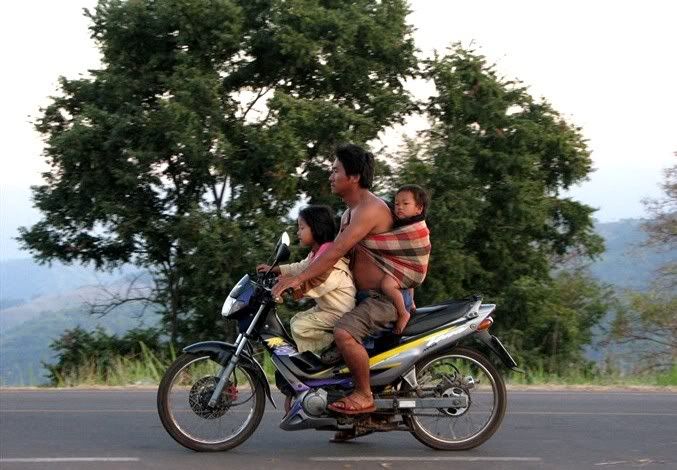 So I was reading through some of my old blog entries from a year or two ago, and I came across this picture, which I thought I would share. The photo is from Thailand, and it really made me ponder how different our cultures are.
I actually had a terrifying nightmare a while back--I could not find my ring sling. Or a pouch. Or the mai-tei. Or a moby, the ellaroo, or any long piece of fabric to tie knots in. In the dream, I grabbed a sweatshirt and tried to tie Esme to me, that's when I woke up.
So I was reading through some of my old blog entries from a year or two ago, and I came across this picture, which I thought I would share. The photo is from Thailand, and it really made me ponder how different our cultures are.
I actually had a terrifying nightmare a while back--I could not find my ring sling. Or a pouch. Or the mai-tei. Or a moby, the ellaroo, or any long piece of fabric to tie knots in. In the dream, I grabbed a sweatshirt and tried to tie Esme to me, that's when I woke up.
When Esme and Eva were younger, I wore them for an average of two to three hours a day. It made life so much easier. I could get chores done while they tagged along or nursed. I did not have to worry about them getting into something they shouldn't. I could play with them, talk to them, sing with them while we did whatever needed to get done. They were constantly part of my life and were exposd to so much. They were always learning! Even now that Esme is two years old, I still wear her, especially if she is tired or in need of mama-love and I still have chores to do or errands to run.
But let me tell you, having an older child, I cannot fathom staying sane without babywearing. It is soooo easy to not have to worry about picking one up and having to find a place to put the one down to pick up the other one. I can wear Esme and pick up Eva at the same time without dropping one or the other. We all can go to the park and swing together, Esme in the pouch or ellaroo, tagging along for the ride (don't worry, I don't go too high). How would we go to crowded school events with a squirmy toddler? Or worse--a gigantic stroller that everyone has to squeeze past or trips over? And almost every day, I learn something new about babywearing--especially like a new position to wear Esme as I do this or do that. There are so many things I can do because of babywearing. And not once in four years of babywearing have I regretted it! I wonder how I could live without babywearing!
Not only does babywearing make life with an infant/toddler convienent, it also has added developmental benefits. When an infant is worn, he is close to his mother, and is able to nurse on demand in an environment that extends the sensation of the womb. The gentle movements of the mother (or father) and the closeness remind the baby of the movements he lived with for nine months in the womb, making for a more content baby, and often lulling baby into a peaceful, uninterrupted rest. Wearing a baby also keeps the baby close when in public, keeping strangers and potential germs at bay and keeping a toddler from wandering away. Also, babywearing helps babies developmentally by encouraging strengthing of neck muscles in the early months, and, because they are at an adult level, they are more easily able to observe what is going on around them and participate in life, which promotes social development and extending entertaining activities.
The environment also benefits when parents decide to babywear. Baby carriers generally contribute less envirnmental impact than other manufactured baby products some parents use, including plastic and metal swings, playpens, strollers, bouncy seats, activity centers, etc. Baby carriers are also substantially cheaper than many of these items, saving your pocketbook, as well.
Now, I was a dedicated slingin' mama when Eva was young, and I wore her until she was nearly two, but I did not discover the wonders of other babywearing devices until I was pregnant with Esme.
There are four main styles and several good name brand carriers available, though many WAHMs (work at home moms) make slings and sell them at very reasonable prices (which is a major plus if you want to pick out your own fabric!).
The first, and most common, type of carrier is the Ring Sling. This is basically a piece of fabric with two rings sewn at one end. The rings sit just below your shoulder. The fabric wraps around your back and across you like a sash and then feeds through the rings. The baby sits in the sash part. The pros of the ring sling are that it is very adjustable and can fit a variety of sized people, allows for a number of holds, it is easy to pop the baby in and out, and the sash/tail provides good coverage for nursing. Cons, the one-shoulder carry can be hard on your back, especially as the baby grows. The beautifully hand-woven Maya Wrap is my favorite, though the following picture is of me wearing Esme in a WAHM sling.
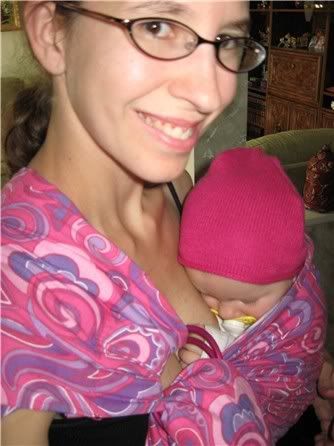
The second type of carrier, and the style I use most often because it is quick and easy, is the Pouch, which is a sewn fabric loop that you wear across you like a sash. When folded and worn, the baby fits into the "pocket" of the pouch. It looks a lot like the ring sling with out the rings or tail. Pros: easy to use, easy to get baby in and out quickly (great for rushed errands), allows for a number of holds, folds compactly and fits perfectly in the diaper bag, easy to nurse "discreetly" with practice. Cons (depending on how you look at it): it is not adjustable, but it is custom sized to fit one person perfectly (which is what I actually like most about it—I never have to readjust it); also, the one-shoulder carry can be hard on your back. The most common brand is Hot Slings http://www.hotslings.com/ (limited patterns are available at Target), but a friend of mine makes beautiful pouches; the following is a picture of me wearing Esme in one of her creations.
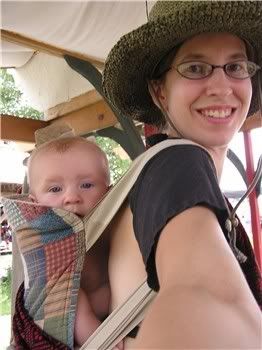
 The third type of carrier is the Asian-style Baby Carriers (Mei Tais, Onbuhimos, and Podaegis fall into this category). The Mei Tai is a Chinese baby carrier. It is the carrier that most closely resembles the Bjorn, though it is pretty different. It is essentially a square of fabric with waist straps and shoulder straps coming out. The square is the baby's seat, and the straps are tied around the babywearer. The Mei Tai is far more adjustable than a Bjorn and does a much better job of distributing the baby's weight over your body. You can carry much larger babies much more comfortably and in several different positions. It also holds the baby's hips in a far more ergonomic position. Onbuhimos and Podaegis tie differently but are similar to Mei Tais in many ways. Pros: easy to use, comfortable, cool for hot summer days, the two shoulder straps helps to distribute weight more evenly, easy nursing, one size fits most. Also makes for the fastest and most secure back-carry. Cons: the straps often hit the ground before you get the carrier tied (ick factor), takes more time to get baby in and out, awkward to wear without a baby inside. If you decide on an Asian-style Baby Carrier, look for one with wide straps, which are far more comfortable than narrow straps! For a while, the most sought after Mei Tai for me was Babyhawk, but I prefer Maya Wrap's Maya Tie much more! Here is a picture of me wearing Esme in a homemade Mei Tai:
The final style is the Wrap. The Wrap is far and away my favorite carrier style. Wraparound style baby carriers are just one long strip of cloth, 18-30" wide, in varying lengths, made of different types of fabric. There are three main fabric types: stretchy (good for new babies, because it is comfy and poppable; try Moby Wrap), woven (all around wrap, supports more weight and distributes weight well; brands include Didymos, Storchenwiege, Girasol, Easy Care, Bebina, Lana, Hoppediz, and Ellaroo) and gauze (cool, comfortable and THIN, which means it is perfect for summer heat and humidity, transporting in the diaper bag, and perfect for back carries; try the beautiful Gypsy Mama Bali Baby Breeze). Whatever you do, do not buy the Ultimate Baby Wrap from Babies R Us, as it is extremely stretchy and does not provide nearly enough support and comfort. Pros of the Wrap: super comfortable, flexible, one size fits most, works for more holds than any other carrier, can be worn without the baby, comfortable for long babywearing excursions and for wearing toddlers and young children. Cons: major learning curve—it takes a lot of practice, there is a lot of fabric to juggle. I specifically like the Ellaroo. Here is a picture of David wearing her in a Maya Wrap:
And a picture of me wearing Esme in my favorite, my woven Ellaroo: 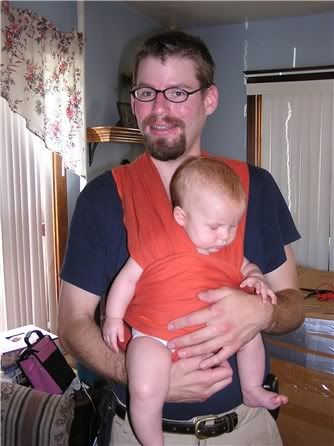


There are also structured carriers like Ergo or Beco. Some people I know really love these, especially men, as they have clips or buckles instead of straps to tie or lots of fabric. I can say for sure that if it is a choice between a Bjorn and an Ergo or Beco, do not take the Bjorn.
You can find a ton of resources at http://thebabywearer.com/, including galleries, videos, instructions, and reviews. Etsy, eBay, and Craigslist are good places to hunt for WAHM-made slings at reasonable prices, as is http://www.thewahmmall.com/. I have coupon codes for a ton of babywearing sites, so if you find something you like, I will see if I have a discount for it. And, so you know, a lot of the name brand slings and wraps hold their value well for resale when your little one grows out of it (especially Ellaroo, Maya Wrap, BabyHawk, Ergo, and Beco)!
Subscribe to:
Posts (Atom)