Sunday, April 19, 2009

leaning toward breastfeeding

A friend of mine is pregnant with her second baby. She did not nurse her first, due mostly to lack of knowledge. When I asked her, she actually had not even considered breastfeeding as an option.

I came across this lovely little article, What if I want to wean? by Diane Wiessinger, which I passed on to my friend in hopes that she will read it and give breastfeeding a shot this time around.

Breastfeeding your baby for even a day is the best baby gift you can give. Breastfeeding is almost always the best choice for your baby. If it doesn't seem like the best choice for you right now, these guidelines may help.

IF YOU NURSE YOUR BABY FOR JUST A FEW DAYS, he will have received your colostrum, or early milk. By providing antibodies and the food his brand-new body expects, nursing gives your baby his first - and easiest - "immunization"and helps get his digestive system going smoothly. Breastfeeding is how your baby expects to start, and helps your own body recover from the birth. Given how very much your baby stands to gain, and how little you stand to lose, it just makes good sense to breastfeed for at least a day or two, even if you plan to bottle-feed after that.

IF YOU NURSE YOUR BABY FOR FOUR TO SIX WEEKS, you will have eased him through the most critical part of his infancy. Newborns who are not breastfed are much more likely to get sick or be hospitalized, and have many more digestive problems than breastfed babies. After 4 to 6 weeks, you'll probably have worked through any early nursing concerns, too. Make a serious goal of nursing for a month, call La Leche League or a certified lactation consultant if you have any questions, and you'll be in a better position to decide whether continued breastfeeding is for you.

IF YOU NURSE YOUR BABY FOR 3 OR 4 MONTHS, her digestive system will have matured a great deal, and she will be much better able to tolerate the foreign substances in commercial formulas. If there is a family history of allergies, though, you will greatly reduce her risk by waiting a few more months before adding anything at all to her diet of breastmilk. And giving nothing but your milk for the first four months gives strong protection against ear infections for a whole year.

IF YOU NURSE YOUR BABY FOR 6 MONTHS without adding any other food or drink, she will be much less likely to suffer an allergic reaction to formula or other foods later on; the American Academy of Pediatrics recommends waiting until about 6 months to offer solid foods. Nursing for at least 6 months helps ensure better health throughout your baby's first year of life, reduces your little one's risk of ear infections and childhood cancers, and reduces your own risk of breast cancer. And exclusive, frequent breastfeeding during the first 6 months, if your periods have not returned, provides 98% effective contraception.

IF YOU NURSE YOUR BABY FOR 9 MONTHS, you will have seen him through the fastest and most important brain and body development of his life on the food that was designed for him - your milk. Nursing for at least this long will help ensure better performance all through his school years. Weaning may be fairly easy at this age... but then, so is nursing! If you want to avoid weaning this early, be sure you've been available to nurse for comfort as well as just for food.

IF YOU NURSE YOUR BABY FOR A YEAR, you can avoid the expense and bother of formula. Her one-year-old body can probably handle most of the table foods your family enjoys. Many of the health benefits this year of nursing has given your child will last her whole life. She will have a stronger immune system, for instance, and will be much less likely to need orthodontia or speech therapy. The American Academy of Pediatrics recommends nursing for at least a year, because it helps ensure normal nutrition and health for your baby.

IF YOU NURSE YOUR BABY FOR 18 MONTHS, you will have continued to provide the nutrition, comfort, and illness protection your baby expects, at a time when illness is common in formula-fed babies. Your baby is probably well started on table foods, too. He has had time to form a solid bond with you - a healthy starting point for his growing independence. And he is old enough that you and he can work together on the weaning process, at a pace that he can handle. A former U.S. Surgeon General said, "it is the lucky baby... that nurses to age two."

IF YOUR CHILD WEANS WHEN SHE IS READY, you can feel confident that you have met your baby's physical and emotional needs in the most normal, healthy way. In cultures where there is no pressure to wean, children tend to nurse for at least two years. The World Health Organization and UNICEF strongly encourage breastfeeding through toddlerhood: "Breastmilk is an important source of energy and protein, and helps to protect against disease during the child's second year of life." Our biology seems geared to a weaning age of between 2 1/2 and 7 years, and it just makes sense to build our children's bones from the milk that was designed for them. Your milk provides antibodies and other protective substances for as long as you continue nursing, and families of nursing toddlers often find that their medical bills are lower than their neighbors' for years to come. Research indicates that the longer a child nurses, the higher his intelligence. Mothers who nurse long-term have a still lower risk of developing breast cancer. Children who were nursed long-term tend to be very secure, and are less likely to suck their thumbs or carry a blanket. Nursing can help ease both of you through the tears, tantrums, and tumbles that come with early childhood, and helps ensure that any illnesses are milder and easier to deal with. It's an all-purpose mothering tool you won't want to be without! Don't worry that your child will nurse forever. All children stop on their own, no matter what you do, and there are more nursing toddlers around than you might guess.

WHETHER YOU NURSE FOR A DAY OR FOR SEVERAL YEARS, the decision to nurse your child is one you need never regret. And whenever weaning takes place, remember that it is a big step for both of you. If you choose to wean before your child is ready, be sure to do it gradually, and with love.

©2000 Diane Wiessinger, MS, IBCLC www.normalfed.com


Bookmark and Share

Wednesday, April 8, 2009

thank you for nursing in public

I began breastfeeding in public shortly after Eva was born, and at the time, I had no idea how significant the act actually is.

When I’m out, I *rarely* see a mama nursing her baby. A while back, we went out for lunch at a local restaurant. I saw a new mama with a few week old baby, and she had Lanolin tucked into the bottle-net of her diaper bag. She did not nurse (and I watched like a hawk), and even though she did not, I was so excited to see another nursing mama—and I would have felt compelled to say something encouraging to her if she had nursed the little one in the restaurant.

When I was visiting family this past spring, a mama was there with her husband and their two kids (2 years and 4 months). The guest list included her husband, her parents, David, me, and all of our children (all of whom had been/are currently being nursed and are used to seeing a nursing baby). But when it was time for the baby to nurse, she left the room. Now, the first time she did this, we were eating dinner and I thought maybe she was hoping to find a more comfortable place to nurse. But, later that day, she left the room again--and this time, Esme and I were rocking quietly in a chair, nursing--and we were the only other ones in the room!

Her behavior made me feel awkward. I wanted to ask her why she kept leaving. There were comfortable places to sit, and the atmosphere was quiet, no matter where we were in the house. *I* sure as hell don’t mind if she nurses! I was nursing my own child throughout the day! And I do not leave to nurse—I nurse with whoever is in the room with us at the moment, wherever we are. It does not bother me, and I dedicate myself to making it normal for whoever is sitting around us. I talk about nursing. I answer questions. I make sure people know it’s normal, legal, and healthy.

Needless to say, I did not ask why she kept leaving, though I did tell her she could stay. Many times. I made that clear.

Another situation: David, Eva, Esme and I dropped in to visit someone at work one afternoon. She loves to see the girls when we stop by, so I walked back to her office so the girls could say hello, and Esme begins making it clear that she wants mama milk. I excused myself, and said, "Esme is ready to nurse. We will be around!"

But then, she said, in a rush, "Oh! Well, here, I am done in here, so you can use the office!"

I declined. She insisted. I relented, though I should not have. I did not want to go into the whole "Nursing-in-public-is-protected-by-law-in-the-state-of-Ohio-and-I-am-allowed-to-breastfeed-whenever-and-wherever-my-baby-needs-to" spiel when it seemed like, from her body language and tone of voice, that she was uncomfortable with the idea of me breastfeeding in the workplace.

[By the way, she recently had a baby boy, who, at five months, is still drinking only mamas milk.]

This situation is completely different from another experience I had at my work when we lived in Wisconsin. When I was on maternity leave, I stopped by to visit my colleagues and show off sweet, newborn Esme. When I went back to see my then manager in his office, we ended up having a good long talk, during part of which Esme nursed. He was at ease the whole time and completely supportive of my nursing in public. Perhaps I owe this to his dear wife, who is a La Lache League Leader and who nursed their two children for 2+ years each.

When we were in Disney World last summer, I saw two or three women nursing. The most significant was a mama who was nursing her three year old in line for and during The Enchanted Tiki Room show. A Spanish-speaking woman, she nursed over the top of her tank top in the front row (of a circular auditorium--I nursed about six seats down, made eye contact, and smiled. I do not speak Spanish, otherwise I would have commended her! An absolutely wonderful experience!

But there is another young mama I know who is uncomfortable nursing in front of others. I do not know her very well, but I want her to know that it is important to nurse in public. It is a simple act, yet at the same time, it is a momentous act.

How many times do you see a nursing mama when you are out? What do you do? Do you smile at her? Do you just go on with your business as if the act of breastfeeding is completely normal (because it is!)? Do you say encouraging words?

I never know quite what to do, though it is so seldom that I see a mama nursing in public that I always want to do something to acknowledge her act in a positive way (though I can always trust Eva to say something along the lines of, "Look, Mama! She nurses her baby, too!"). When someone says something positive to me, or just makes eye contact and smiles, it makes me feel good to know that someone appreciates the significance of breastfeeding in public—and the significance of breastfeeding in general!

I printed up some notes (the image at the top of this entry), little business cards, with a few words of thanks to hand out to the NIP mamas I see. I figure it is another important and essential step that I need to take to make a return to breastfeeding as the norm in our culture. I included the International Breastfeeding Symbol on the card, but since since I travel so much, I did not include any specific state legislation.

Here is a beautiful breastfeeding letter from Best of Craigslist. It brings tears to my eyes:


Date: 2006-11-21, 10:07PM PST

I happened to be on an Airplane
from Shrevesport two weeks ago. Those tend to be small and crowded.

I sat next to a young lady, perhaps 20 or so. She was carrying a small
child, who was quite unhappy with the pressure changes and all.

She got up several times to go to the bathroom, each time I had to rise to
let her out. I knew she was comforting the child, I even asked her if she
wished the aisle seat.

She blushed and said she preferred the inside seat. The flight got a little rough,
the seat belt light came on along with a warning from the Captain, and he
wasn’t kidding, it got very rough.

She looked quite miserable, the child was crying. The ears of the very young are quite sensitive, they have not learned to compensate so nursing is very beneficial at times like that.

When the flight began to calm I mentioned to her that it was all right to comfort her child at her seat, I did not mind.

She smiled and thanked me, I suppose the fact that I am obviously a bit grandfatherly relaxed her. So she did, I simply read my book. Several around noticed but none took offense.

One funny thing, the steward came by, a young man of perhaps 30 or so,
bringing soft drinks. This was after things had settled down a bit. She was
asleep, as was the child. It had a solid locklip on her breast, both were quite
content. He asked me if my daughter wanted anything, I got some Orange juice
for her and set it on her tray. She woke up soon after, drank it and thanked me.

I even got to hold the child for awhile, a wonderful feeling bringing back
some memories of my youth and my own children.

I confess to a small tear in my eyes at touching a hand nearly as small as
my index finger.

Perhaps my being much older makes a difference, but breastfeeding is a
wonderful thing to see. Even as a male, a tiny child pressing to my chest feels
just fine.

Look down on it all you wish, those who do are fools. Women should feed their children as nature intended, they will be stronger and healthier as a result. I see nothing wrong with it, if bashful or in a highly public place, a simple blanket will suffice. If not, that does not matter, it did not for the young lady sharing a long trip with me.

My wife nursed ours until they turned to solid foods, often in public. Not one time did anyone say anything.

It might be time for some to rub a bit of the blue off their noses, this is a
very silly thing to take any offense at. Courtesy would dictate that we simply
go on our way and let the young mothers be.

It is just nature at work.

The following is a NIP story I read on Mothering a while back. It is an uplifting story, and I saved it because I did not want it to be lost for eternity in the forum-abyss!

About a year ago i was out with a friend who was just getting used to NIP
with her 3 month old daughter. We were in a coffee shop (Tinderbox, GLasgow, UK if anyone is interested). I'd been NIP in there from when DD was 10 days old so it seemed a good place for her to take the plunge.

Anyway babe woke, mama got to nursing.

An old man, at the next table, immediately began to grumble and mutter.
Soon he was loud enough that we could hear the grumblings of "disGUSting" and
"public decency" and "should be ashamed". I just held my friend's eye contact
and gave her my "Your legal right!" look (legally protected in the UK to
NIP).

A few moments of this passed and then a member of staff passed, clearing
tables. Old man pipes up "Aren't you going to do anything about her feeding THAT
in here!? It's disgusting! They should be thrown out!" My friend was getting
twitchy. I put a hand on her arm, and said "steady" under my breath.

The member of staff, a boy of about 18, looked at the old man, looked at us
and said "one moment sir" to the old guy. He vanished. A moment later he
returned with a paper cup and lid. He put the paper cup on the old guy's table,
picked his half-drunk coffee up, poured it into the cup, put the lid on and then
holding the cup out to the old guy said "You can't see them from outside, which
is where you're going now."

The old guy had a face like THUNDER but he left. We smiled sweetly and
BROADLY at him as he left.I could have KISSED that boy! They have a BF-friendly attitude in there but this is seriously fabulous!

Check out Nursing is Normal, a photographic display of mothers nursing in public places. The NIN Project was started by Kathy O'Brien (a doula and photographer in Fort Worth, Texas) with the intention of helping women to feel comfortable nursing in public.
Here is a Breastfeeding Report Card and other noteworthy breastfeeding information, mostly statistics, but the information about the survey is interesting, too.

Also, First Right is a site that protects breastfeeding and promotes it as the cultural and biological norm. On this site, breastfeeding discrimination can be reported, and action against discrimination is organized.

One more, an awesome site where you can buy the International Breastfeeding Symbol in a variety of formats--free shipping!


Bookmark and Share

Tuesday, April 7, 2009

library

2 young girls 1 tired adult 2 days left to pick up my books from the library's hold shelf 1 (short) nap that day 45 minutes before the veggie bake is ready 1 determined visit to the library 5 times I said "Walking feet, inside voices!" 7 board books gleefully discovered & brought, one by one, by Esme 2 visits to the bathroom initiated by children 0 visits to the bathroom initiated by me 2 minutes between bathroom visits 1 colossal temper tantrum by Esme 2+ dollars paid in fines because I am not as observant of due dates as I used to be 1 greeting by Story Time woman, who I met when came with my 10 month old only child 1 forehead sweaty from exertion 3 times I wondered how Story Time woman's perception of me has changed in the past 7 years 8 books for girls 2 books for me 0 minutes left on oven timer when we arrived home

Sunday, March 29, 2009

babywearing

So I was reading through some of my old blog entries from a year or two ago, and I came across this picture, which I thought I would share. The photo is from Thailand, and it really made me ponder how different our cultures are. I actually had a terrifying nightmare a while back--I could not find my ring sling. Or a pouch. Or the mai-tei. Or a moby, the ellaroo, or any long piece of fabric to tie knots in. In the dream, I grabbed a sweatshirt and tried to tie Esme to me, that's when I woke up.
When Esme and Eva were younger, I wore them for an average of two to three hours a day. It made life so much easier. I could get chores done while they tagged along or nursed. I did not have to worry about them getting into something they shouldn't. I could play with them, talk to them, sing with them while we did whatever needed to get done. They were constantly part of my life and were exposd to so much. They were always learning! Even now that Esme is two years old, I still wear her, especially if she is tired or in need of mama-love and I still have chores to do or errands to run.
But let me tell you, having an older child, I cannot fathom staying sane without babywearing. It is soooo easy to not have to worry about picking one up and having to find a place to put the one down to pick up the other one. I can wear Esme and pick up Eva at the same time without dropping one or the other. We all can go to the park and swing together, Esme in the pouch or ellaroo, tagging along for the ride (don't worry, I don't go too high). How would we go to crowded school events with a squirmy toddler? Or worse--a gigantic stroller that everyone has to squeeze past or trips over? And almost every day, I learn something new about babywearing--especially like a new position to wear Esme as I do this or do that. There are so many things I can do because of babywearing. And not once in four years of babywearing have I regretted it! I wonder how I could live without babywearing!
Not only does babywearing make life with an infant/toddler convienent, it also has added developmental benefits. When an infant is worn, he is close to his mother, and is able to nurse on demand in an environment that extends the sensation of the womb. The gentle movements of the mother (or father) and the closeness remind the baby of the movements he lived with for nine months in the womb, making for a more content baby, and often lulling baby into a peaceful, uninterrupted rest. Wearing a baby also keeps the baby close when in public, keeping strangers and potential germs at bay and keeping a toddler from wandering away. Also, babywearing helps babies developmentally by encouraging strengthing of neck muscles in the early months, and, because they are at an adult level, they are more easily able to observe what is going on around them and participate in life, which promotes social development and extending entertaining activities.
The environment also benefits when parents decide to babywear. Baby carriers generally contribute less envirnmental impact than other manufactured baby products some parents use, including plastic and metal swings, playpens, strollers, bouncy seats, activity centers, etc. Baby carriers are also substantially cheaper than many of these items, saving your pocketbook, as well.
Now, I was a dedicated slingin' mama when Eva was young, and I wore her until she was nearly two, but I did not discover the wonders of other babywearing devices until I was pregnant with Esme.
There are four main styles and several good name brand carriers available, though many WAHMs (work at home moms) make slings and sell them at very reasonable prices (which is a major plus if you want to pick out your own fabric!).
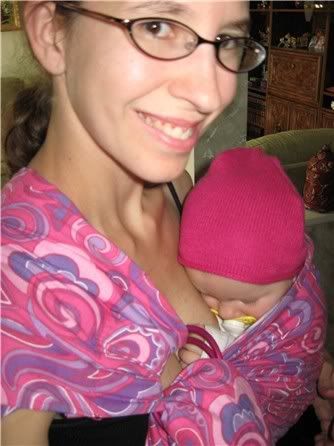
The first, and most common, type of carrier is the Ring Sling. This is basically a piece of fabric with two rings sewn at one end. The rings sit just below your shoulder. The fabric wraps around your back and across you like a sash and then feeds through the rings. The baby sits in the sash part. The pros of the ring sling are that it is very adjustable and can fit a variety of sized people, allows for a number of holds, it is easy to pop the baby in and out, and the sash/tail provides good coverage for nursing. Cons, the one-shoulder carry can be hard on your back, especially as the baby grows. The beautifully hand-woven Maya Wrap is my favorite, though the following picture is of me wearing Esme in a WAHM sling.
The second type of carrier, and the style I use most often because it is quick and easy, is the Pouch, which is a sewn fabric loop that you wear across you like a sash. When folded and worn, the baby fits into the "pocket" of the pouch. It looks a lot like the ring sling with out the rings or tail. Pros: easy to use, easy to get baby in and out quickly (great for rushed errands), allows for a number of holds, folds compactly and fits perfectly in the diaper bag, easy to nurse "discreetly" with practice. Cons (depending on how you look at it): it is not adjustable, but it is custom sized to fit one person perfectly (which is what I actually like most about it—I never have to readjust it); also, the one-shoulder carry can be hard on your back. The most common brand is Hot Slings http://www.hotslings.com/ (limited patterns are available at Target), but a friend of mine makes beautiful pouches; the following is a picture of me wearing Esme in one of her creations.
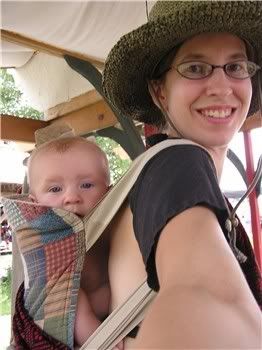
The third type of carrier is the Asian-style Baby Carriers (Mei Tais, Onbuhimos, and Podaegis fall into this category). The Mei Tai is a Chinese baby carrier. It is the carrier that most closely resembles the Bjorn, though it is pretty different. It is essentially a square of fabric with waist straps and shoulder straps coming out. The square is the baby's seat, and the straps are tied around the babywearer. The Mei Tai is far more adjustable than a Bjorn and does a much better job of distributing the baby's weight over your body. You can carry much larger babies much more comfortably and in several different positions. It also holds the baby's hips in a far more ergonomic position. Onbuhimos and Podaegis tie differently but are similar to Mei Tais in many ways. Pros: easy to use, comfortable, cool for hot summer days, the two shoulder straps helps to distribute weight more evenly, easy nursing, one size fits most. Also makes for the fastest and most secure back-carry. Cons: the straps often hit the ground before you get the carrier tied (ick factor), takes more time to get baby in and out, awkward to wear without a baby inside. If you decide on an Asian-style Baby Carrier, look for one with wide straps, which are far more comfortable than narrow straps! For a while, the most sought after Mei Tai for me was Babyhawk, but I prefer Maya Wrap's Maya Tie much more! Here is a picture of me wearing Esme in a homemade Mei Tai:
The final style is the Wrap. The Wrap is far and away my favorite carrier style. Wraparound style baby carriers are just one long strip of cloth, 18-30" wide, in varying lengths, made of different types of fabric. There are three main fabric types: stretchy (good for new babies, because it is comfy and poppable; try Moby Wrap), woven (all around wrap, supports more weight and distributes weight well; brands include Didymos, Storchenwiege, Girasol, Easy Care, Bebina, Lana, Hoppediz, and Ellaroo) and gauze (cool, comfortable and THIN, which means it is perfect for summer heat and humidity, transporting in the diaper bag, and perfect for back carries; try the beautiful Gypsy Mama Bali Baby Breeze). Whatever you do, do not buy the Ultimate Baby Wrap from Babies R Us, as it is extremely stretchy and does not provide nearly enough support and comfort. Pros of the Wrap: super comfortable, flexible, one size fits most, works for more holds than any other carrier, can be worn without the baby, comfortable for long babywearing excursions and for wearing toddlers and young children. Cons: major learning curve—it takes a lot of practice, there is a lot of fabric to juggle. I specifically like the Ellaroo. Here is a picture of David wearing her in a Maya Wrap:
And a picture of me wearing Esme in my favorite, my woven Ellaroo:
There are also structured carriers like Ergo or Beco. Some people I know really love these, especially men, as they have clips or buckles instead of straps to tie or lots of fabric. I can say for sure that if it is a choice between a Bjorn and an Ergo or Beco, do not take the Bjorn. You can find a ton of resources at http://thebabywearer.com/, including galleries, videos, instructions, and reviews. Etsy, eBay, and Craigslist are good places to hunt for WAHM-made slings at reasonable prices, as is http://www.thewahmmall.com/. I have coupon codes for a ton of babywearing sites, so if you find something you like, I will see if I have a discount for it. And, so you know, a lot of the name brand slings and wraps hold their value well for resale when your little one grows out of it (especially Ellaroo, Maya Wrap, BabyHawk, Ergo, and Beco)!

Friday, March 27, 2009

stockpiling for catastrophe

I was sorting through some papers on my desk, and I flipped to a list of the Top 100 Items to Disappear First During a National Emergency. I don't remember where I found the list, but it is circulating.

Top 100 Items to Disappear First During a National Emergency
1. Generators (Good ones cost dearly. Gas storage, risky. Noisy...target of thieves; maintenance etc.)
2. Water Filters/Purifiers
3. Portable Toilets
4. Seasoned Firewood. Wood takes about 6 - 12 months to become dried, for home uses.
5. Lamp Oil, Wicks, Lamps (First Choice: Buy CLEAR oil. If scarce, stockpile ANY!)
6. Coleman Fuel. Impossible to stockpile too much.
7. Guns, Ammunition, Pepper Spray, Knives, Clubs, Bats & Slingshots.
8. Hand-can openers, & hand egg beaters, whisks.
9. Honey/Syrups/white, brown sugar
10. Rice - Beans - Wheat
11. Vegetable Oil (for cooking) Without it food burns/must be boiled etc.,)
12. Charcoal, Lighter Fluid (Will become scarce suddenly)
13. Water Containers (Urgent Item to obtain.) Any size. Small: HARD CLEAR PLASTIC ONLY - note - food grade if for drinking.
16. Propane Cylinders (Urgent: Definite shortages will occur.)
17. Survival Guide Book.
18. Mantles: Aladdin, Coleman, etc. (Without this item, longer-term lighting is difficult.)
19. Baby Supplies: Diapers/formula. ointments/aspirin, etc.
20. Washboards, Mop Bucket w/wringer (for Laundry)
21. Cookstoves (Propane, Coleman & Kerosene)
22. Vitamins
23. Propane Cylinder Handle-Holder (Urgent: Small canister use is dangerous without this item)
24. Feminine Hygiene/Haircare/Skin products.
25. Thermal underwear (Tops & Bottoms)
26. Bow saws, axes and hatchets, Wedges (also, honing oil)
27. Aluminum Foil Reg. & Heavy Duty (Great Cooking and Barter Item)
28. Gasoline Containers (Plastic & Metal)
29. Garbage Bags (Impossible To Have Too Many).
30. Toilet Paper, Kleenex, Paper Towels
31. Milk - Powdered & Condensed (Shake Liquid every 3 to 4 months)
32. Garden Seeds (Non-Hybrid) (A MUST)
33. Clothes pins/line/hangers (A MUST)
34. Coleman's Pump Repair Kit
35. Tuna Fish (in oil)
36. Fire Extinguishers (or..large box of Baking Soda in every room)
37. First aid kits
38. Batteries (all sizes...buy furthest-out for Expiration Dates)
39. Garlic, spices & vinegar, baking supplies
40. Big Dogs (and plenty of dog food)
41. Flour, yeast & salt
42. Matches. {"Strike Anywhere" preferred.) Boxed, wooden matches will go first
43. Writing paper/pads/pencils, solar calculators
44. Insulated ice chests (good for keeping items from freezing in Wintertime.)
45. Workboots, belts, Levis & durable shirts
46. Flashlights/LIGHTSTICKS & torches, "No. 76 Dietz" Lanterns
47. Journals, Diaries & Scrapbooks (jot down ideas, feelings, experience; Historic Times)
48. Garbage cans Plastic (great for storage, water, transporting - if with wheels)
49. Men's Hygiene: Shampoo, Toothbrush/paste, Mouthwash/floss, nail clippers, etc
50. Cast iron cookware (sturdy, efficient)
51. Fishing supplies/tools
52. Mosquito coils/repellent, sprays/creams
53. Duct Tape
54. Tarps/stakes/twine/nails/rope/spikes
55. Candles
56. Laundry Detergent (liquid)
57. Backpacks, Duffel Bags
58. Garden tools & supplies
59. Scissors, fabrics & sewing supplies
60. Canned Fruits, Veggies, Soups, stews, etc.
61. Bleach (plain, NOT scented: 4 to 6% sodium hypochlorite)
62. Canning supplies, (Jars/lids/wax)
63. Knives & Sharpening tools: files, stones, steel
64. Bicycles...Tires/tubes/pumps/chains, etc
65. Sleeping Bags & blankets/pillows/mats
66. Carbon Monoxide Alarm (battery powered)
67. Board Games, Cards, Dice
68. d-con Rat poison, MOUSE PRUFE II, Roach Killer
69. Mousetraps, Ant traps & cockroach magnets
70. Paper plates/cups/utensils (stock up, folks)
71. Baby wipes, oils, waterless & Antibacterial soap (saves a lot of water)
72. Rain gear, rubberized boots, etc.
73. Shaving supplies (razors & creams, talc, after shave)
74. Hand pumps & siphons (for water and for fuels)
75. Soysauce, vinegar, bullions/gravy/soupbase
76. Reading glasses
77. Chocolate/Cocoa/Tang/Punch (water enhancers)
78. "Survival-in-a-Can"
79. Woolen clothing, scarves/ear-muffs/mittens
80. Boy Scout Handbook, / also Leaders Catalog
81. Roll-on Window Insulation Kit (MANCO)
82. Graham crackers, saltines, pretzels, Trail mix/Jerky
83. Popcorn, Peanut Butter, Nuts
84. Socks, Underwear, T-shirts, etc. (extras)
85. Lumber (all types)
86. Wagons & carts (for transport to and from)
87. Cots & Inflatable mattress's
88. Gloves: Work/warming/gardening, etc.
89. Lantern Hangers
90. Screen Patches, glue, nails, screws,, nuts & bolts
91. Teas
92. Coffee
93. Cigarettes
94. Wine/Liquors (for bribes, medicinal, etc,)
95. Paraffin wax
96. Glue, nails, nuts, bolts, screws, etc.
97. Chewing gum/candies
98. Atomizers (for cooling/bathing)
99. Hats & cotton neckerchiefs
100. Livestock

With unemployment and recession hitting us at home, we were happy to have stockpiled some of our basic necessities, including grains and beans, flour, frozen and jarred veggies and fruit, olive oil, paper products, batteries, borax and baking soda, vinegar, and a number of reusable (versus disposable) products. We have put a dent in our stockpile, and need to boost it up again. I would ideally have 3 months supply of food to fall back on, if needed.

Here are a couple of useful links:

Basic food storage guide lines http://www.trackmyfoodstorage.com/ar...eid=4&zoneid=1
Prepping guide http://athagan.members.atlantic.net/Index.html

Saturday, March 21, 2009

educational children's music

Now that Esme is two, she has really taken off in her interest in music. For her birthday, we gave her a Makala Soprano Ukulele and her second homemade handdrum, both have really inspired her to play and practice like Daddy. The uke is a very solid instrument for a very reasonable price, nearly equivilant to some professional ukuleles.
Esme and Eva are both singers by nature. It is actually strange for there to be quiet in our house--someone is always making music, whether it is David practicing or recording, Eva and Esme singing, snapping, clapping, drumming, playing their ukes or Eva's guitar. Music is terribly important to development in children, especially in relation to spacial, mathematic, logical and kinesthetic intelligences. We encourage musical expression in our home and lives--and musical development is as important to our children's basic development as walking and talking.
Our latest find, thanks to a friend, is directed specifically at pre-school aged childre, The Cool Alphabet Song by Didi Pop. I have to share it because Esme loves it so much:

Monday, March 16, 2009

cloth pads: yes, women do have options!

I absolutely LOVE cloth pads. I have used them since dear Flo returned nearly a year after Evelyn was born. I actually came across them when I was searching eBay for cloth diapers, and I became absolutely excited about the idea of wearing something fun, interesting, and comfortable during the few days when I was usually crampy and, to be honest, itchy from the paper irritation.

I have not had my period in a good long while, and when Esme was postpartum, I used mostly the larger cloth pads that came in my birth kit. Since I was only just pregnant back when we had our house fire, most of my pads were lost in the fire. I still have four or five that were in my purse at the time--luckily they are my favorites. But Esme is 11 months old, about two weeks older than Eva was when Flo returned for her usual visits. And from what I understand, Flo returns about the same time postpartum for each child a mother has (depending on a few factors, including exclusive breastfeeding duration, among other things--though I have not had any signs whatsoever of my cycle starting up again). So, I figure--better to be prepared! I'm shopping for pads!

I mentioned the prospect to a couple of friends recently, and they were shocked--"Cloth pads! Eeewww! What? I've never heard of such a thing! Why?"

I attribute this response to isolation and lack of knowledge. So, to spread the wealth...

The official definition: A cloth menstrual pad is a reusable menstrual product that absorbs the menstrual flow. It is an absorbent pad made from layers of absorbent fabric such as cotton flannel, hemp, terry cloth, etc.

So, why use cloth pads, you ask? There are countless reasons.

Because they are made from natural fabrics, cloth pads are more comfortable, being softer, more breathable, and less irritating than their disposable counterparts. There is also no chance for any unwanted and painful sticking to sensitive skin and hair.

By using cloth pads, you can improve your health by reducing your exposure to harmful chemicals. Disposable pads contain a variety of chemicals, bleaches, and additives, all of which are easily absorbed into your body through your sensitive genital tissue, causing irritation and discomfort, as well as increasing cramping and bleeding, and lengthening duration.

Cloth pads are better for the environment. By using (and reusing) cloth pads, you are not contributing to the obscene amount of waste going into landfills. Disposable menstrual products do not break down, nor can they be recycled. In many cases, cloth pads can be made from recycled materials, such as old cotton pillowcases or pajamas, and, years down the road, when they are thoroughly worn out, they can go into compost rather than the landfill. And, with proper care, cloth pads can literally last five to eight years--or more--costing you a fraction of the amount you would have otherwise spent on disposable menstrual products.

Perhaps the most satisfying reason to switch to cloth pads--you will feel more in touch with your body, empowered by not throwing away a part of your body. Women who use cloth pads feel better about themselves, more connected with their cycles, and have a more positive attitude to themselves and menstruation--not to mention the self-expression that goes into picking out the fabrics and designs of your own cloth pads!

Cloth pads have been around for a very long time, but have changed dramatically from what they used to be. Cloth pads of the past were nothing like the designer cloth pads made today. Instead, they were generally made from old sheets, scraps of cloth, toweling, etc. Women of the past would fold the fabric into a rectangle of many layers and some would use pins to secure the folded fabric into place. Some of the "nicer" pads were sewn together with loops and tied at the hip or waist to secure it into place. While these types of pads are examples of what women of the past used, women still use cloth pads similar to these in some areas of the world. Here is an example of what they look like:

Photobucket

There are many styles of cloth pads to choose from nowadays, however, most commonly either AIO (all in one) or holder/insert construction.

AIO (all in ones) pads: The AIO pad consists of only the one pad, usually with attached wings to secure it to the undergarment. Advantages are that it is just one piece, with no assembly required. Disadvantages are that you need many different sizes since they are not adjustable to your flow like the holder/insert style. Because they are one piece, they are generally thicker, which can make it difficult to tell when a change is necessary (unable to peek between layers). The thickness also makes thoroughly washing them a little harder (in the center/core). They also take longer to dry. Here is a picture of one of a few of my own cloth pads:

Photobucket

Holder/insert pads: The holder and insert pad has the holder which is secured to the undergarment and the inserts which are separate absorbent pads that are secured to or inside the holder. Advantages to this style is it allows you to adjust the number of inserts to accommodate your flow. With this style, it is easier to see if a change is necessary by checking between the layers. The layers are thinner (although there are more pieces) which makes thoroughly cleaning them easier. They dry faster since the layers are separate. Disadvantages are having several pieces to assemble and clean. The following images are courtesy of Sew Green's Cloth Pad Insert tutorial:

Photobucket

Photobucket

Photobucket

Photobucket

Women have alternatives. We have a choice. We do not have to be dependent on corporations and chemicals. We owe it to ourselves to not be bullied or embarrassed by those who are close-minded or unwilling to be different from what society has told us is acceptable.


And caring for your cloth pads is easier than you might think. Follow these simple steps for your handmade pads, or your manufacturers guidelines.

Before using your cloth pads, they must be washed. The more you wash them, the more absorbent and the softer they will become. To wash your pads, place them in a mesh laundry bag and wash them on the gentle cycle in cold water or wash them by hand. Cloth pads can be dried by laying them flat to air dry, hanging them to dry, or tumble drying them on medium. Do not use fabric softener or dryer sheets as they can interfere with the absorbency of the pads.

To use your cloth pad (which depends on the design), secure the pad to your undergarment. Most cloth pads have wings and are secured with a snap. When you are first learning to use cloth pads, it may be necessary to check the pad often to prevent leaking through until you are comfortable in knowing that you are using the correct size pad for your flow and how often to change your pad.

After use, rinse your pads in cold water as soon as possible to prevent stains from setting and place them in a soaking container filled with cold water until they can be thoroughly washed. Be sure to replace the water daily. On wash day, simply remove your pads from the soaking container and place in a mesh laundry bag and wash as suggested above. To prevent stains, remember to rinse your pads immediately after use and soak them in cold water until they can be washed. If pads are allowed to dry, then they are likely to stain, and the stains will be very difficult to remove.

Using cloth pads when you are away from home is simple. Most cloth pads fold up nicely and snap with wings and can easily be placed in a purse or pouch. For used pads, a leak-proof bag, known as a "wet bag," is ideal. A wet bag can be anything from a small cosmetics bag, a pouch made of a water-resistant fabric, or a zip-top plastic bag. Simply fold the used pad and stow it discretely in the wet bag until you get home.


Some suggested websites:
http://www.gladrags.com/
http://www.lunapads.com/

Make your own cloth pads:
http://www.fuzbaby.com/articles/makeyourown_clothmenstrualpads.htm
http://shewhorunsintheforest.googlepages.com/0011
http://www.diapersewing.com/clothpads.htm

My new favorites:
Mommy's Touch: http://mamaclothonline.com/item_21/Mommys-Touch-Cloth-Pads.htm